
A Modern Chronergy Rolex, a Timer, and the Ghost of the Observatory Trials
Timer Games with a 2026 Superlative Chronometer

The observatory trials are no longer the organising centre of wristwatch credibility, but they still haunt modern chronometry.
Every time a brand claims precision, stability, regulation, or some long-term reliability, it is leaning on a version of the old observatory promise: that the watch will not merely run, but run consistently under conditions that expose weakness.
Especially true if it is a brand that once did well there but has since drifted. Rolex is an opposite case. Rolex hardly entered (8 watches ever) and scored a best ‘N score’ of 13.4 in 1947, last appearing in 1953. It was barely a presence in the trials compared with Longines, Omega, Zenith et al. Yet modern Rolex is arguably one of the most consistent industrial chronometer-makers at scale.
We have already looked at modern chronometry trials, unpicked the new COSC Excellence Chronometer against METAS Master Chronometer, and questioned how much Jaeger LeCoultre’s HPG standard really proves.
As I lead up to publishing the analysis of how modern watches might have performed at the ‘original’ observatory trials, it felt worth benchmarking a random sample of the latest output from Rolex since they enhanced their in-house trials.
New Superlative Chronometer
My original Chronergy analysis was from 2021 six years after launch. Since then Rolex has had more than a decade to refine the 32xx architecture and the Chronergy escapement in production and more recently further enhanced their in-house protocols. Although as usual, details are impossible to really determine from public sources. Rolex’s 2026 update to the Superlative Chronometer certification quietly added three new pillars:
resistance to magnetism,
long-term reliability,
and sustainability
but does so in a characteristically opaque way: all three are implemented at the design and manufacturing stage rather than as end-of-line tests on finished watches.
The famous ±2 s/day precision tolerance remains unchanged.
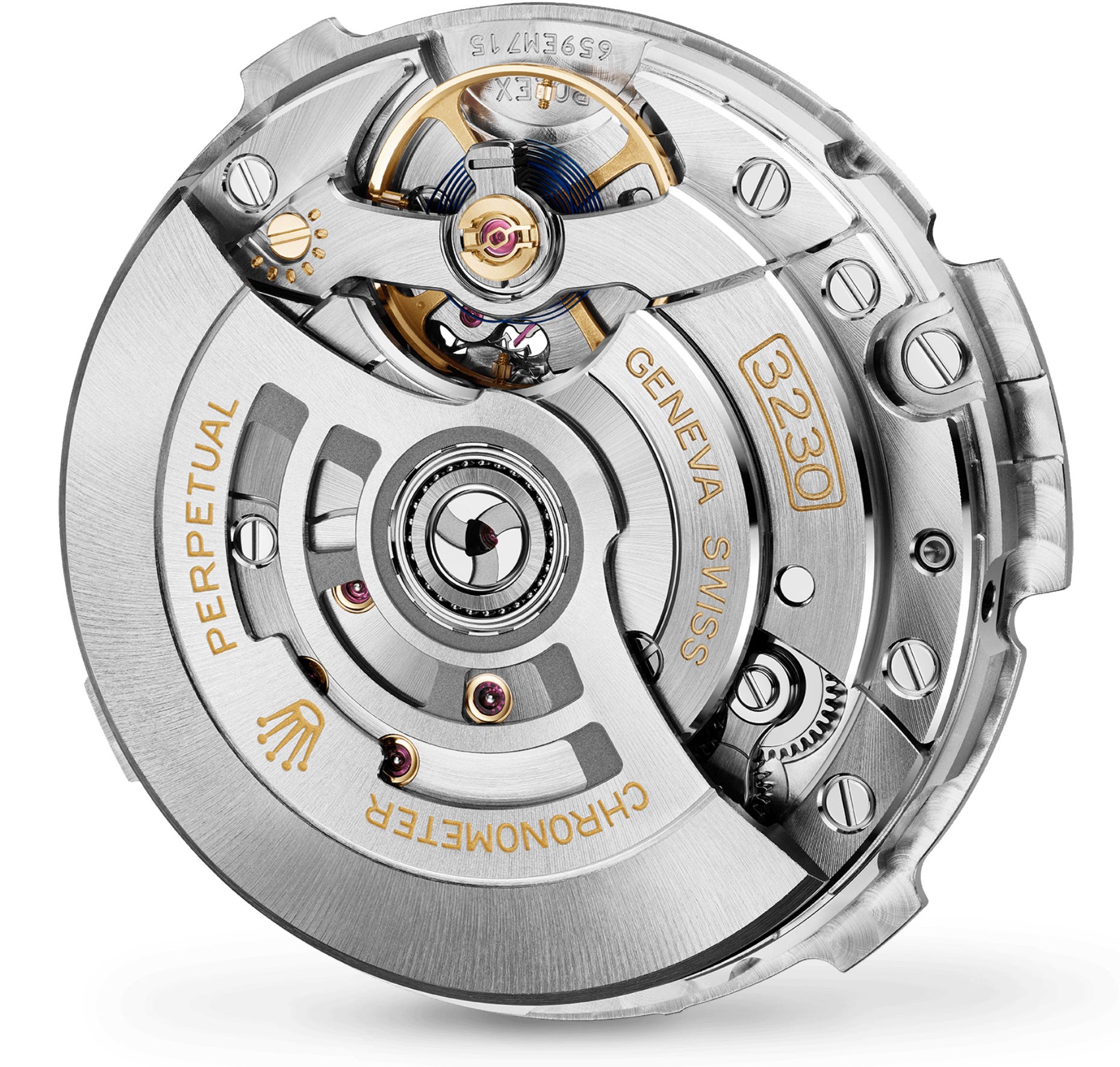
The “reliability” pillar is likely backed by a protocol similar to Chronofiable A8 with Rolex’s internal robot-arm wear simulators that compress a lifetime of wrist movement, crown actuations, and shock events into days, though the exact cycle counts and test durations remain undisclosed.
In practice, the 2026 protocol appears to be a formalisation and public certification of testing Rolex already performs internally rather than a step-change in technical specification; more marketing codification than engineering revolution.
Rolex has not published a specific gauss threshold for the new magnetism criterion, likely because its existing Parachrom Bleu and Syloxi hairsprings already sit far beyond the industry-minimum ISO 764 baseline of roughly 60 Gauss.
Parachrom-like alloys are now out of patent coverage and well understood, while the soft-iron cage used in the earlier 116900 Air-King has disappeared from the modern 126900. That does not prove the current Air-King is a 2,000 Gauss watch. Rolex has not published a number, and this test did not measure magnetic resistance.
The safer conclusion is narrower: modern Rolex anti-magnetism is almost certainly being managed well above the old industry baseline, even if Rolex refuses to quantify it. The relevance of the 2,000 Gauss figure is not that it can be claimed for this Air-King, but that comparable non-caged, paramagnetic hairspring approaches using similar metallic formulations elsewhere have already now reached that territory.
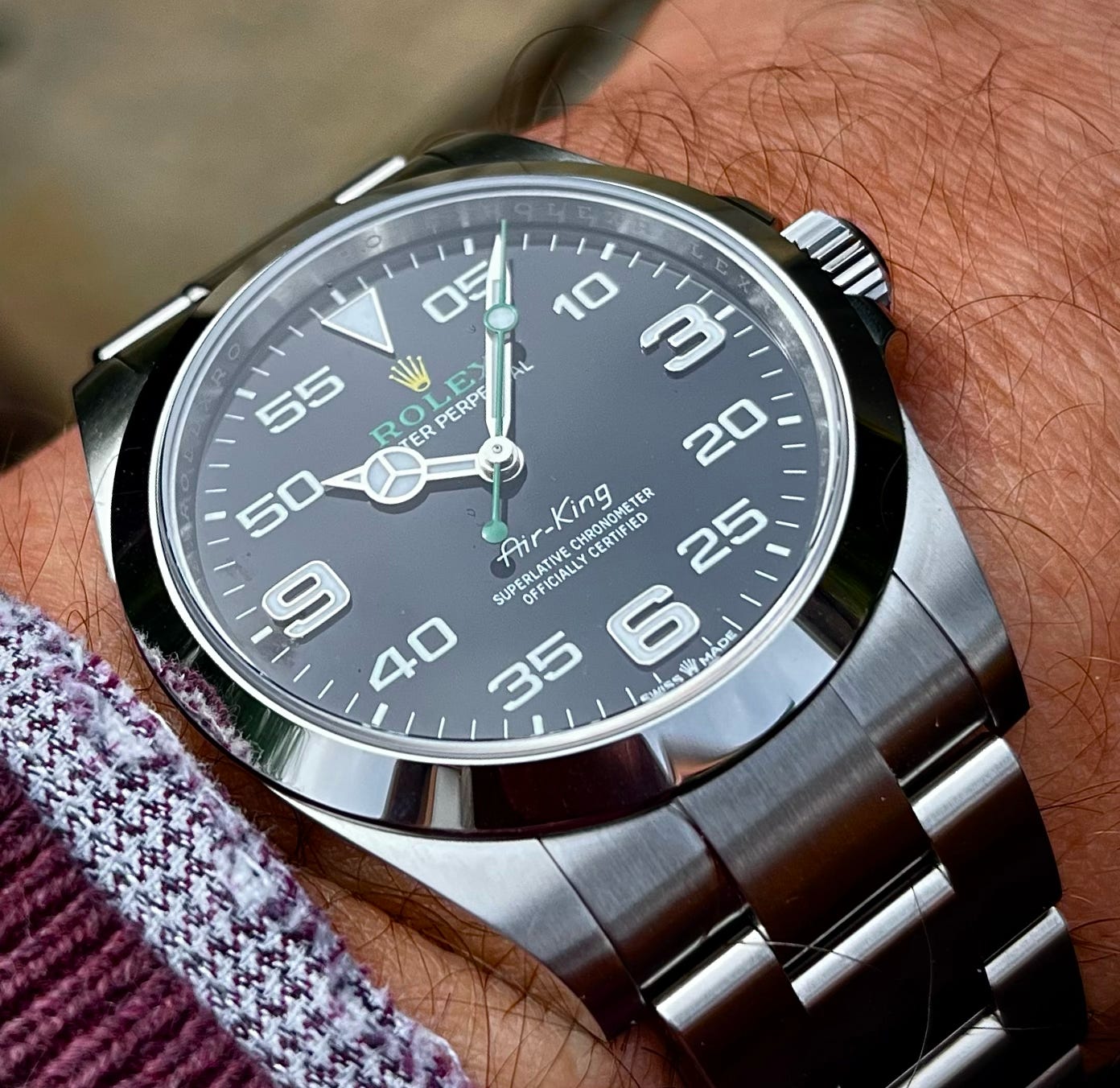
Love it or hate it, the Rolex Air-King (126900) is not only much better than its earlier incarnation (116900 with cal 3131) in every way, it carries the very latest cal 3230.
Timing this watch cannot recreate an observatory trial, and a few bench readings cannot replace long-duration rate observation. But they can show whether the basic architecture is behaving like a serious chronometer: whether the positional spread is narrow, whether amplitude collapse is controlled, whether the rate remains useful as the mainspring winds down, and whether the claimed precision looks like marketing or engineering.
Below the paywall, the timer starts: full wind, 24 hours, 48 hours, amplitude quirks, positional spread, METAS-style wind-down behaviour and a cautious attempt to place a modern mass-produced Rolex against the ghost of the observatory trials.
The care needed with snapshot timing results
It’s very easy to produce all manner of nonsense with a timer. I measured the rate continuously (settings to give a 20s sample average) and then took the average of readings over the time taken for